Training for Tetrathlon
By Sarah Evers Conrad, USPC Marketing and Communications Director
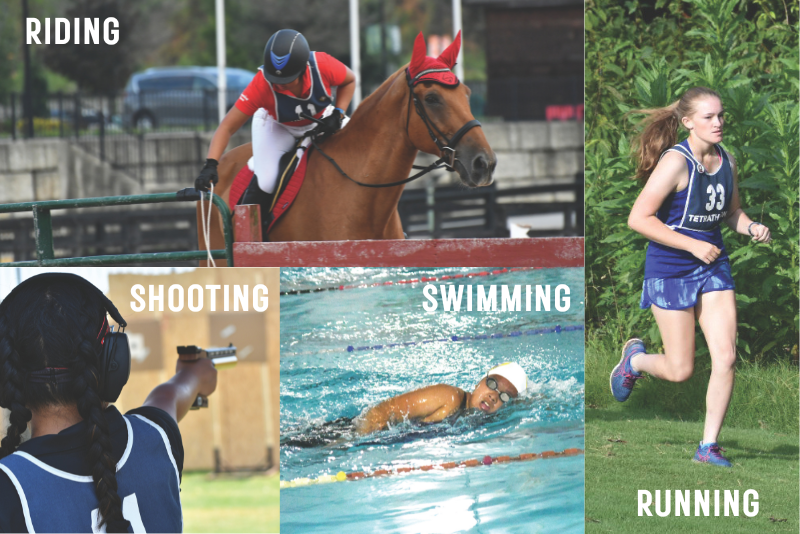
If you’re thinking about expanding your Pony Club experience and trying something new, there’s one discipline that can give you a lot of variety and excitement. Tetrathlon—which combines riding, swimming, running, and shooting—offers the ultimate sporting experience for riders of all ages and experience levels. Pony Club is the only organization in the United States that offers Tetrathlon competition.
In Tetrathlon, often referred to as “Tet,” Pony Club members follow the USPC Tetrathlon Rulebook. Since it is a USPC competitive discipline, opportunities include Tetrathlon rallies, inter-regional rallies, and USPC Festival Championships every other year. Competitors earn scores in all four phases, which are then combined with their Horse Management score to determine overall placings in a competition.
- The running phase challenges each competitor’s physical stamina and endurance over cross-country terrain and may include obstacles such as hay bales, logs, and low fences.
- The shooting phase tests a competitor’s skill and accuracy in a standing position using an air pistol at a distance of 10 meters from a target.
- The swimming phase features a set course length, with points awarded depending on the time for completion.
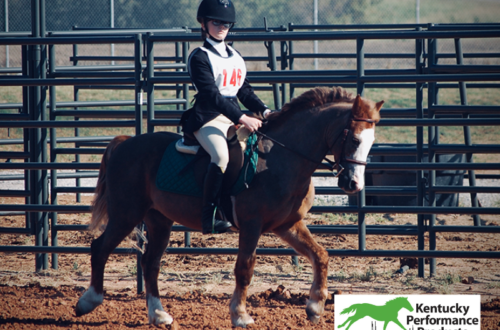
- The riding phase of competition provides an opportunity for the rider and mount to demonstrate equestrian skills over a jumping course designed with stadium or cross-country obstacles, or a combination of both that often includes natural terrain. Competitions may also involve an equitation round.
Tetrathlon’s equestrian phase is different than other events you may see that involve jumping in that there is a slip rail and a gate. “It tests the rider’s ability to keep their horse adjustable through the course to pull up for the gate and slip rail, which is a crucial part of becoming a mature [skilled] rider,” said Annie Rogers, an H-A Horse Management and B Eventing member of Radnor Hunt Pony Club in the Eastern Pennsylvania Region.
Rogers, a second-generation USPC member, began competing in Tetrathlon at a regional Tetrathlon rally in the fall of 2015 and competed throughout high school and at the 2018 USPC Championships East in Tryon. She has also volunteered as a scorer and as Tetrathlon Secretary at the 2023 USPC Championships East. She shared her love of the discipline on the Pony Club Podcast.
Ariana Dickey, a H-B Horse Management, C-2 Eventing, C-2 Dressage member of Seneca Valley Pony Club in the Capital Region, has been hooked on Tetrathlon since 2012 and has competed in the Capital Region Tetrathlon rally every year since then and also at the Maryland Region Tetrathlon rally since 2018.
Benefits for the Rider
There are many great reasons to give Tetrathlon a try, and the horse can also learn new skills. Benefits of competing in Tetrathlon for the rider include:
PHYSICAL FITNESS: By competing in four disciplines, you develop a great foundation for staying physically fit for riding and in life, which is just as important for horseback riders as it is for other kinds of athletes. Rogers said this is a major issue with many riders. “We don’t always treat ourselves like the athletes that we are,” she said.
For the running phase, participants run distances based on their age, starting at 500 meters (1/3 of a mile) for the youngest participants, and they work their way up to 3,000 meters (or 1.86 miles) for those age 16 and above in the junior and senior divisions. In swimming, the youngest competitors start at 25 yards (or meters) and the longest distance is 200 yards (or meters) for juniors and seniors, which is equal to four laps of an Olympic-sized pool.
Running is known to create better sleep, control weight, improve brain function and cardiovascular health, lower blood pressure, reduce pain and stress, improve mental health, and provides many more overall benefits. Swimming works the entire body and builds muscle strength and flexibility, increases endurance, and provides many of the same physical benefits as running. And don’t get us started on all the benefits of riding…we’d be here all day.
FRIENDS: While making friends is a key benefit of Pony Club, riders may find a special kind of camaraderie within Tetrathlon. Rogers said her favorite part is the generosity of the riders, parents, and the stewards. “I really love the people who compete in Tetrathlon, and I appreciate the recognition it gives to our Pony Club members who are involved in sports outside of riding,” she said.
Dickey also enjoys the people and the uplifting, supportive atmosphere of Tetrathlon. “Out of all the different events I’ve competed in, Tetrathlon has been the most fun,” said Dickey. “Since Tetrathlon combines multiple disciplines, it creates a sense of camaraderie that makes competing even more special.”
PRACTICAL SKILLS: The shooting phase of Tetrathlon teaches concentration, hand-eye coordination, patience, self-discipline, responsibility, safety, and can boost self-esteem and confidence. The swimming phase builds strong skills in water, which can help prevent an accidental drowning.
For the equestrian phase, Rogers cites being able to open a gate while being mounted and being able to mount a horse safely from the ground as two practical skills that can be used for any type of riding.
TIME MANAGEMENT: In order to train for four sports, athletes must make wise use of their training time. “Training for the other sports may decrease your ride time, so it makes the time you do get to ride that much more impactful,” said Rogers.
BENEFITS FOR THE HORSE: If a horse already knows how to jump and handle natural terrain, then he does not need any further special training for this discipline; however, a horse will get lots of practice with patience as the rider practices opening and closing a gate. Rogers said that learning to navigate the slip rail and gate obstacles can help enhance a horse’s responsiveness to cues, as well.
Training for Tet
To get started, Rogers recommends reaching out to the District Commissioner of your club or to your Regional Supervisor to find out who in the club and/or region does Tetrathlon. If you find yourself a trailblazer in your area, she recommends beginners read the rulebook to understand the phases and how the competition is run.
“Do your best to practice your running, swimming, and shooting as often as you can,” she adds. “Depending on where you live, it can be difficult to train for Tet, but the first time doing it should be about having fun and learning about how to improve your training.”
Our athletes offer training tips for each phase of Tetrathlon.
EQUESTRIAN: If your goal is to ride in an international exchange to represent the U.S. and USPC, Rogers advises to practice switch rides. “Being timely, neat, presentable, and good mature riders is the best representation we can give,” she added.
Dickey suggests creating a practice setup at home for the slip rail with two standards and two poles and to also practice the gate at home.
RUNNING: Being a good runner means building up your cardio capabilities and your endurance. “If it’s your first time running at an event, I recommend training for a distance slightly longer than what you’ll be running in competition,” said Dickey. “This will make the actual race feel easier and allow you to put in more effort.”
SWIMMING: Dickey emphasized the importance of breath control and muscle conditioning for swimming. “Practice every three strokes for a breath, and work on your kicking to strengthen your legs,” she advised.
SHOOTING: Dickey recommends shooting from a closer distance at first than the required distance for a competition and then gradually increasing the range. “One of the best tips I’ve learned is to put masking tape over your non-dominant eye to help keep both eyes open, which makes focusing much easier, and puts less strain on your non-dominant eye.”
Muscle training is also important for a steady aim when shooting. “For muscle training, practice holding for 6×20 second lifts and 30 seconds rest,” advised Dickey. “Aim to shoot at least twice as many shots as you will in competition, and practice the holding technique to build steady aim.”
Tetrathlon Opportunities Near and Far
Members who excel in Tetrathlon can go on to represent USPC and compete in the Pony Club International Alliance (PCIA) Tetrathlon Exchange, which includes teams from the United States, United Kingdom, Ireland, New Zealand, and Australia.
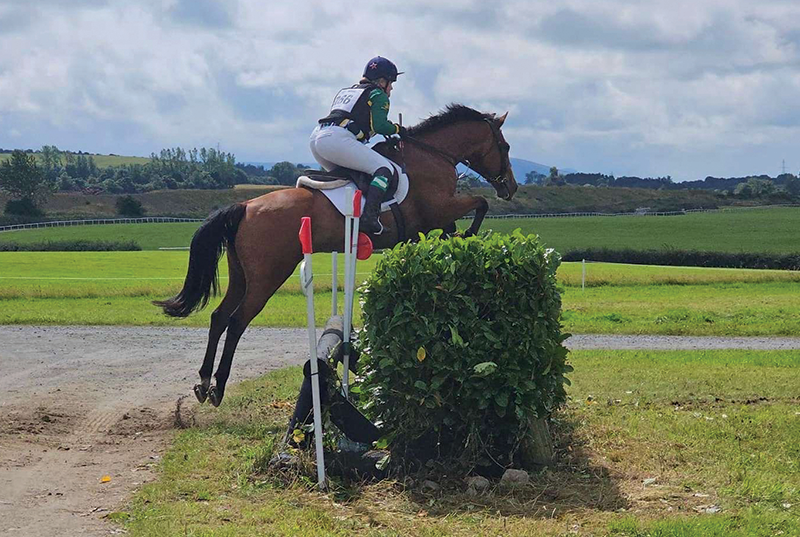
Rogers got to experience the 2024 PCIA Tetrathlon Exchange in the United Kingdom and Ireland.
“I had always heard wonderful things about the Tet exchange, and I thought it was a once-in-a-lifetime opportunity to ride a beautiful Irish horse across an Irish cross-country course,” said Rogers. “For me, this trip was a way for me to finally check something off my list after COVID and to learn how the other Pony Clubs conduct competitions so that I could bring that knowledge back to the U.S. I’d do it again in a heartbeat.”
Dickey wasn’t able to do an international exchange due to the pandemic and her college schedule, but added that she has made great connections that led her to become part of The Ohio State University (OSU) pistol team, which captured the 2024 national championship title with Dickey competing on the team.
“I believe Tetrathlon offers countless opportunities, not just for competition, but for personal growth and making lasting friendships,” said Dickey. “It’s a discipline I truly love, and I highly recommend it to anyone looking for a fun, multifaceted, and challenging sport.”
This article was originally published in the Winter 2024 issue of Discover USPC magazine. Read more content from that issue.

Sarah Evers Conrad
Sarah Evers Conrad is the Marketing and Communications Director for the United States Pony Clubs. She has worked with USPC since 2022. Prior to her tenure at USPC, she was the Digital Content Editor for Horse Illustrated and Young Rider magazines; the E-Communications Director for the United States Equestrian Federation; Managing Editor for USEF's Equestrian magazine, and she began her career on the staff of The Horse magazine. She has also freelanced for numerous equestrian publications and owned her own marketing agency.


You May Also Like

Member Spotlight: Alexandra Frailey

Adult Pony Club Member Joan Leuck-Waak