
Overcoming 8 Everyday Arena Problems
By Meg Finn, USPC Instruction and Testing Coordinator
As a rider, it’s only natural that problems will arise while you are working with your horse, and the types of scenarios are too numerous to count. However, almost every rider will deal with at least one of the eight issues below. Let’s take a look at these common problems and ways to deal with them.
Problems in the arena can be a result of any number of factors, such as a behavioral issue, improper or ill-fitting tack, discomfort, or a health condition. Determining the root cause of the problem will help you determine the best way to resolve it. It’s important to work with your veterinarian to rule out any physical problems first. Once you’ve ruled out illness or injury, it’s always a good idea to work with a trainer who can help you with these scenarios (and others), especially if you are struggling on your own.
#1. Headshaking
If you’ve ruled out a physical cause (fly spray and ear bonnets can be very beneficial during the summer months), you’ll want to consider what you’re asking your horse to do. If you’re asking him to go into a corner of the arena that he dislikes and he’s shaking his head in response, redirect your horse’s focus. A great way to do this can be incorporating poles or cavaletti into your work. Giving both you and your horse something else to focus on, rather than focusing on the problem, can help direct his energy in a positive manner. Ride a dressage test or a flat pattern or add in transitions or more complex movements—a leg yield, shoulder-in, or haunches-in—to get your horse forward-thinking.
#2. Refusing a Jump
A horse can stop at jumps for a wide variety of reasons. Is he new to jumping? Is this a jump he is scared of or intimidated by? Does he understand what you are asking?
If your horse is stopping because he is new to jumping, don’t fault him. Go back to basics. Lower the jump or take it down to a single pole on the ground, if needed. One exercise to practice includes using a ground pole as a transition point. The goal is to have the pole become the very first stride of a canter. Practice trotting up to a pole, then ask for the canter as the horse goes over the pole. This helps teach the horse to move forward, then up and in an arc over an obstacle, while also teaching the rider when to put leg on.
Now, if your horse is stopping because he is scared, allow him time to investigate. Ask your mount to walk up to the jump. Let him sniff it and touch it with his nose. Walk around the jump and let him see it out of both eyes. Horses process things very differently from the left and right eye, and their vision is very different from ours, because their eyes are on the side of their head. Next, practice walking quietly towards the jump and stop at it, staying straight. If the horse can stop near it, with his head and neck looking out and over the fence, you’re ready to reapproach.
Is your horse running out to the side? This is a common problem. A horse running out to the side means the rider has not done their job of steering. If you feel your horse start to drift, stop him immediately. Steering should always be the number one priority before adding in speed (or height). Widen your hands and use your seat and leg to channel your horse’s energy straight and forward.
If your horse is stopping because he doesn’t understand what you are asking, just slow down! This can happen when both horse and rider are overwhelmed. Add in circles or break to the walk or trot to allow both of you time to think. As you and your horse gain confidence, gradually add height back in. Set your horse up for success. It can take a long time to develop confidence, for both horses and riders, but no time at all to destroy it.
#3. Constantly Pulling Rails
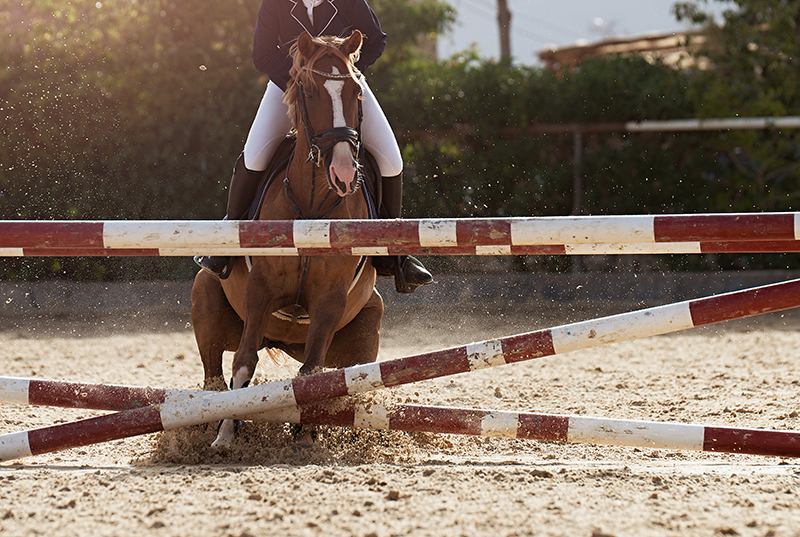
Some horses are naturally more careful jumpers than others. Bold and brave doesn’t always equate to being a careful jumper. Jumping requires a different type of strength and fitness. Focus on your horse’s footwork. Trot and canter poles, cavaletti, and gymnastic exercises are a wonderful way to address this.
For more experienced jumpers, add in fences that will get your horse’s attention. You can use filler (flower boxes, panels, barrels, or gates), add a pole on the landing side of a fence (10′ to 12′ after the fence, depending on the size of the horse’s stride), or add in trot fences. Or ride a gymnastic line (appropriate for you and your horse) using cross-rail bounces and oxers with ground poles between fences. Get your horse to sit and push so he learns to jump in an arc rather than flat over a fence. When you get your horse to slow down and think about his feet, this will help him jump in a better shape.
#4. Jumpiness/Spooking
Horses can spook at just about anything. Instinctually, they are flight animals. It’s in their DNA to physically react when they feel threatened, which is often caused by a lack of confidence. The more relaxed we are, the more relaxed our mount will be. Focus on your own breathing, talk to your horse, count strides, or sing a song.
Next, get your horse in front of your leg—he should be listening, quick to react, and ready to move forward when you apply your aids. Practice transitions between gaits, as well as within the gaits. If you or your horse are feeling nervous, do these transitions on a circle. Progress to simple exercises that you know you can both easily do, such as serpentines and figure-eights.
While it’s important to get your horse’s attention, you always want to set him up for success. Perform exercises you know you can accomplish easily and remember to praise him. Like us, horses learn from being told what they did right, not what they did wrong.
#5. A Half-Asleep Horse
A horse that’s dull to the aids can be a wonderful horse to learn on. He will forgive our mistakes and won’t overreact when a rider gives a cue incorrectly or too strongly. It’s easy to become “loud” with our aids, but to get our horses to listen, we often need less leg, rather than more. Turn it into a game!
As you trot around the arena, take your leg off. See how long it takes for your horse to slow down. Wait until your horse breaks to the walk. As he does, give him three firm kicks to send him forward again. It’s okay if he breaks into a canter. I don’t punish forward movement as I’d rather just allow him to naturally come back to the trot at this point. Repeat the exercise.
The key to this game is to keep from using constant leg pressure, which is much harder than it sounds. After a couple of times, you’ll find your horse moving forward as soon as you increase leg pressure. Don’t forget to add variety to your rides to keep things interesting for both you and your horse. Ride with a friend, play mounted games, go for a hack. All these things can help keep your horse mentally fit, and physically fit as well.
#6. Speeding Up
You should identify why your horse might be turning into a speed demon. Does he have too much energy? You may want to consider longeing him. If that isn’t an option, I like to work on a circle and do a lot of trot and canter transitions. Get your horse’s energy out on your terms rather than his.
Is your horse nervous? If so, you’ll want to work on relaxation. The more relaxed a horse is, the easier it is to get him to slow down. Start (and end) your ride with a long walk. Incorporate free walk and stretching circles into your ride. Changing directions frequently and circling can help slow down a speedy mount. Allow your horse to go straight when he goes the speed you want, and circle when he speeds up. When you transition to a halt, does your horse take a deep breath, a sign of relaxation? When he does, praise him. Take breaks and give him time to process your riding lesson.
Does your horse lack balance? A loss of balance often creates a change in speed. Horses, like us, will often speed up when they trip in an effort to regain their balance.
If losing balance is the issue, check your own balance. Stand in a 2-point position. Are you balancing on the reins or do you need to grab mane? Then ride without one or both stirrups. Take a longe line lesson when possible to improve your own balance.
To help build your horse’s balance, perform lots of transitions. Teach him to carry his weight on his haunches. Collect and lengthen the stride at the walk, trot, and canter. And finally, work outside the arena, especially up and down hills when possible.
#7. Cutting Corners
Horses that cut corners have either learned to do this or lack suppleness through their bodies that enables them to bend properly. If your horse cuts corners because you’ve allowed him to, work on your steering. It can help to place a cone in the corner and ride your horse around the cone.
If he lacks suppleness, add in circles, changes of direction, and lateral work (if appropriate). Try adding a circle in every, or alternating, corners. While it’s tempting to pull the outside rein, this often causes the head to go to the outside while the shoulder and barrel fall in. Instead, practice bending your horse to the inside while adding inside leg to move his body out. Encourage your mount to bend through the rib cage with your lower leg. At either end of the arena, spiral in and out on a circle. If you get your horse supple and responsive to your leg aid, this allows you to ride into corners better.
#8. Straight Lines
Riding a straight line is harder than it sounds. Once you’ve mastered staying on the rail, it’s time to introduce quarter lines and centerlines. I recommend a marker at either end of the arena, which gives you a focal point. Place cones or poles parallel to the rail and practice riding a straight line on either side of them. Riding a straight line at the walk can sometimes be harder than at the trot…it’s a bit like trying to ride a bicycle slowly. Adding forward movement can help. Horses need suppleness and balance to be able to maintain straightness. The more you focus on these basics, the easier it’ll be to get your horse to move in a straight line.
With issues that arise while riding, take a moment to ask yourself what is happening and why is it happening. Being a good rider means being able to problem-solve. Try these techniques the next time you encounter these common problems.
This article was originally published in the Winter 2024 issue of Discover USPC magazine. Read more content from that issue.


You May Also Like
