
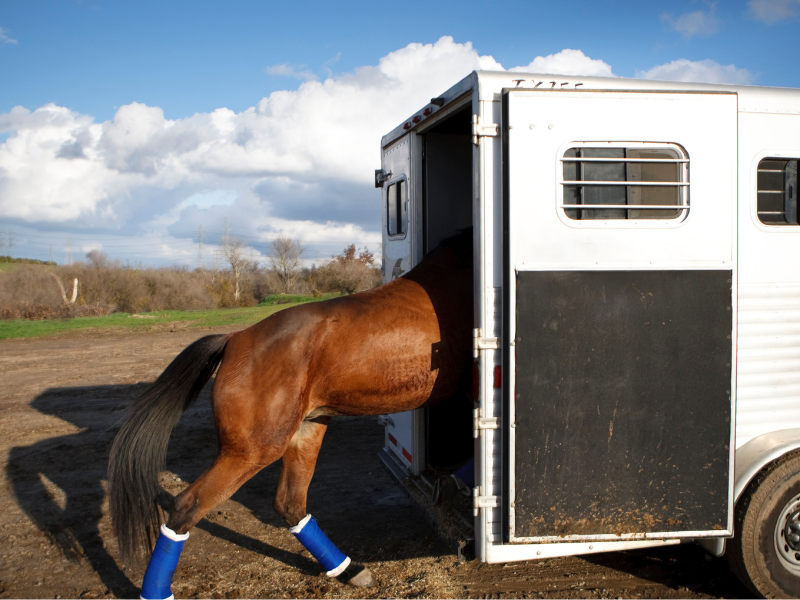
Travel Tips for Horse Owners: Staying in a Horse Hotel
By Lorelei Wilson Coplen, USPC Board of Governors and USPC Founders Award Winner
When I was a growing up, my family moved—a lot. In fact, there was a period of several years when we moved houses and school districts every summer. While it was challenging enough to move furniture and change schools, it was harder to move the horses who were a large part of my family’s life.
My Army dad would normally find out sometime after New Year’s where we going to live next. At some point in early spring—in the midst of planning for events, rallies, and other competitions—my mom would pull out the USPC Annual Directory, which was well-worn, travel-stained, and dog-eared, and lay it in the middle of the kitchen table or counter. She would sit next to a phone with a long extension cord, spread that year’s edition of the interstate atlas, and drag a notepaper and pen next to her. By the end of the evening, the route of our summer’s migration was outlined in red inside the atlas, and the Directory sported notes attached by paperclips to selected pages.
Later, in the earliest days of my own military career, I also grabbed the Annual Directory and an atlas whenever I was changing assignments. Our routes from the old to the new location were rarely the shortest distance between the two—or, three, or, four—points. While we tried to choose ways that kept us on the road a mere seven or nine hours of travel, what was most important was finding a safe place for the horses at the end of each day.
Finding that safe place was the purpose of the USPC Annual Directory. We were confident that anyone or any place that was recommended to us by some name in the Directory was going to have our horses’ best care in mind during our stay. Consequently, when we finally got a farm of our own a few years ago, conveniently located off of a well-travelled interstate, I knew I wanted to host layovers to be that safe place, as well.
For almost ten years—with a break during the pandemic—we have enjoyed the visits of regular horse guests who migrate, like the geese, two times a year from north to south and back again. We also have many one-timers that pass on the way to new homes or new competitions. In my experience as a traveler with horses as well as a horse layover host, there are a few things to consider as you make your own horse-in-tow travel and layover plans.
Tips for Horse Travel
Do your homework. This first tip seems simple but can take some time. Ask your horse friends for their advice about your upcoming long-distance trip; do online research and read articles about travelling with your horses (like this one), compare costs, time, and the care that will be provided to your horses; and make phone calls, if necessary.
Commercial or Private Hauling: One major decision to make is whether you will send your horse on a commercial carrier or haul with a private rig, such as your own horse trailer. The commercial rigs have their own advantages and disadvantages, from cost to amount of care. In many cases, a commercial hauling company is the best way to safely move your horse for most long-distance hauls. However, there are often reasons why a commercial hauler is not appropriate, such as when you are moving your residence, or if you already know your horse will not be comfortable in a commercial carrier’s care as they may drive for numerous hours straight through to the destination with limited stops. And frankly, commercial shipping is extraordinarily expensive!
Planning to Haul Yourself: If you decide you are going to move your horse in a private rig, get ready to make a plan. Figure out what roads you want to use and how long you want to travel, USPC Corporate members can go to the modern version of the USPC Annual Directory on the USPC website—simply log into your USPC profile.
Or you can search online for various websites for horse travelers using search words like “horse hotel,” “horse motel,” and “layovers with a horse” in combination with towns near the area you want to try to stay for a night. Most places you find online will have an email address as well as a phone number. Send an email to make contact, even if you are not certain yet of your plans. If you do not hear anything from the barn owner within 24 hours, call. That way you can find out sooner than later if the barn will have availability or not during your travel time frame
Make sure you keep track of your contacts and communication during your research and planning. I once waited patiently for a guest at my farm, only to have her call and ask me where I was. She claimed to be sitting in my driveway. I could clearly see that she wasn’t there. After a bit of back and forth, I realized that she was at another farm several miles further away. They were not expecting her, so she ended up back at my barn many hours later than either of us planned.
Your Horse’s Hotel
What is a horse motel or hotel?
Firstly, it is not like an impersonal hotel for people, but more like an old-fashioned hostel (a budget-friendly accommodation where guests rent a single bed in a shared space rather than a private room). Think “bed and breakfast” for horses, but you are the one providing your horse’s breakfast. You can expect a bed for your horse—a safe, clean stall with fresh water in the buckets (a stall that you don’t have to clean before you leave the next day)—but don’t expect a private barn or a lot of special amenities. While a few horse hotels are large commercial spaces with lots of empty stalls, most layover facilities are small privately-owned barns where the hosts offer a stall for your horse amongst their own horses for a night (or two) for an agreed-upon price. If you do want or need something extra—for example, turnout time, a wash stall, or a bale of hay—ask ahead of time and be prepared to pay for the additional services.
If you do have a special requirement, please be as accommodating as you can to allow your host to help you. I had a guest tell me, upon her arrival, to strip the rubber-mat stall I had just prepared for her horse because she was allergic to shavings. It would have been more helpful to tell me before she arrived.
For most hosts, the layover business is not their main income, but a sideline (secondary job or business) that provides a service for a nominal expense. During your stay, you may also experience boarders, those taking lessons, and others on a layover. In today’s economy, most layover hosts also work at daily jobs away from their farms, so they are not at the barn or farm during normal work-day hours.
Booking Your Trip
While you should make your stall reservation days, weeks, or even months before your trip, you will also want to call again at least three days in advance to confirm before you get on the road with your horse. Sometimes your call will remind the host that you are coming, but the call will primarily allow you to find out what the local road conditions and predicted weather forecast will be when you arrive.
A serious blizzard left a tree down across the road to my house for several days; and one of the hurricanes of last year flooded our roads. Each time, we had to make special arrangements for our layover guests! We managed, however, because most horse people are tough people.
Every time you call, you should indicate when you expect to arrive, and, also importantly, when you plan to leave the next morning. This allows your hosts to plan the barn chores and lessons around your stay, as well as keep their boarders informed. You should also call while on the road to keep the host(s) informed of your timeline and if you are going to be late, and especially if you are going to be early (in case they are not going to be there).
While on your trip, if you are having trouble with a horse or truck or trailer issues, your layover host might be able to give you the contact information of local vets and farriers, or local truck and trailer mechanics, letting them meet you upon your arrival to the barn.
When you arrive, make sure you show your papers to your host BEFORE you unload. Many states require interstate travel certificates from your veterinarian that are current for any period of 10 to 90 days (depending on the states you are passing through), including a negative Coggins test. For more information, visit the website of your State Veterinarian to find out what is required, along with all states you will be traveling through.
If your horse is patient on the trailer, you may want to see where your stall is before you unload. This gives you a chance to check out the stall and ensure it is ready for your horse and to ask the host if there are any things about the barn that you need to know, such as where the light switches are located, if there are any “barn closed” hours, what time is too early (or too late) to leave in the morning.
During Your Stay
At that point, your host may be ready to let you unload and put your horse away by yourself. Or they may be willing to help you in any way you need—you have only to ask. One recommendation I have is to keep the halter on, especially so the owner can catch an unfamiliar horse if they needed to or in case of emergency.
However, before they leave, make sure you pay your bill for the full amount that was agreed upon. Add on the extras (turnout, hay, etc.). Most places do not take credit cards, and quite a few will only take cash, so be prepared. If the host went above and beyond to accommodate you, it is polite to offer something extra.
If you plan to clean out your trailer that night or the next morning, ask your host where you can deposit your manure, and do not just assume you can figure it out. If you want to drop the trailer for the night, check with your hosts before you do so in order to make sure it is not in anyone’s way.
Also, you may want to inquire if they do a late-night check or feed in the morning and if there is a fee. At our farm, I always make sure our guests know that I do a late-night check of water and give hay, just in case they want to leave some hay for their own horses. I also offer to feed the guest horses in the morning, so they are not watching while my own horses eat and so they can get a good hour of digestion before they get on the road again that day.
The morning after your layover, after your horse is loaded, go back to the barn and make sure you did not leave anything behind. If you turned on a light, turn it off. If you opened a gate or door, close it.
One final note—even the most well-travelled horse can occasionally balk at loading. Plan for it. If you oversleep or are running late the next morning, let your hosts know so they can adjust their own schedule.
Your Accommodations
Most people go to a nearby motel or a bed-and-breakfast. However, some people travel with living quarters or campers attached to their trailers, and others want to pitch a tent or sleep in the truck. Make sure you check with the hosts before you assume you are sleeping on their property. They may have concerns, including local ordinances, that may preclude your stay. If they do give you permission to stay on their property, be prepared to pay a “site fee,” like a campground, on a sliding scale depending on your electric and/or water requirements. More limited, but sometimes available, is the use of a guest room in the host’s home.
The Most Important Advice
There is a“Travel Safety”chapter in the USPC Safety Handbook, which can be found at the bottom of the Safety page on the website. It covers the best practices of travel with horses, from truck and trailer maintenance and checks you should do weekly, monthly, and yearly. The Safety Handbook also includes information for an equine first-aid kit. You will want one by your side if you end up on the side of the road or when you get to your layover stay and find that your pony picked up some boo-boos in the trailer that day.
While we now find directions on our phone apps, I still have an atlas stashed under the seat in my truck since barns still tend to be in remote areas with limited cell towers. Also, in my glove box sits a printout of the Regional Supervisor phone numbers of every USPC Region I will cross in my travels. I maintain them as emergency references, since even a well-maintained truck or trailer can experience mechanical issues—or the well-planned route gets detoured or delayed due to weather, construction, or accidents. I know I can still count on the general helpfulness and kindness of new Pony Club friends and other horse friends during any long-distance travel, just as I did when I was younger. And I have obviously not forgotten. Safe travels!

USPC National Office
The United States Pony Clubs, Inc. (USPC or Pony Club) is the largest equestrian educational organization in North America. Started in 1954, the organization has developed curriculum that teaches safe riding skills and the care of horses through mounted and unmounted lessons. Through Pony Club, members have fun with horses and make lifelong friends while they develop skills, habits, and values that extend well beyond the barn and last a lifetime. Many members apply what they have learned in the USPC program successfully in their careers, educational and volunteer opportunities, and other life pursuits.


You May Also Like

New World Screwworm Confirmed in Texas and New Mexico Horses
Take Your Horse to Boarding School