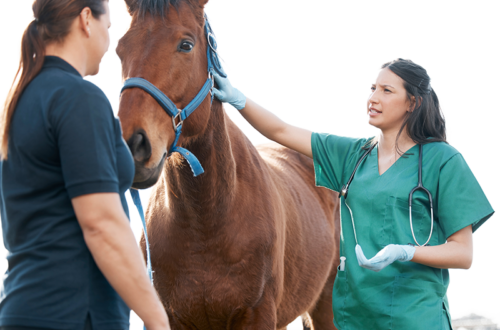

Can You Recognize If Your Horse is in Pain?
By Stacy Anderson, DVM, PhD, DACVS-LA, USPC National Examiner
As the United States Pony Clubs (USPC or Pony Club) incorporates horse well-being formally into its curriculum, one of the aspects of well-being that all Pony Club members should know, as well as all horse caregivers, is how to recognize signs of pain. As USPC members progress through the Horse Management curriculum, they identify specific types of pain, like lameness and colic, but what about recognizing subtle pain?
There is a rapidly growing body of evidence that is now enhanced by artificial intelligence technology that allows veterinarians and horse owners to recognize subtle signs of pain. But why is it difficult to recognize subtle signs of pain in horses?
The reason why might just tie in with the fact that horses are prey animals. They evolved to hide signs of pain from predators because predators recognize pain as weakness and that makes any animal in pain a target for a predator’s next meal.
A Window into Pain
“The eyes are the window to your soul,” so said playwrite William Shakespeare.
Indeed, horse’s eyes and facial expressions are the key to recognizing subtle signs of pain. Other helpful physical clues are the height of the head and the tail. When horses are in pain, they tense muscles in the face, including those around the eyes, mouth, and jaw.
The Equine Grimace Scale is a validated observational tool that allows veterinarians and horse owners to classify subtle pain in a horse’s face. It is composed of six areas of the horse’s head that change in response to pain.
6 Signs of Pain in the Equine Face

1. Ears: The positioning of the ears when held in tension indicates pain. Horses generally move their ears frequently as they observe and react to their environment. When a horse is in pain, his ear movement decreases due to tension in the ear muscles. The ears may be held in tension to the side or slightly backward. Ear tension can also be present when ridden. Veterinarian and researcher Sue Dyson, MA, VetMB, PhD, DEO, has found a strong association between a horse holding the ears back for a prolonged period of time and pain under saddle.
Take a moment the next time you are around your horse to observe their ear movements—both on the ground and under saddle.
2. Eyes: Tightening of the muscles around the eyes from pain causes the eye to look more closed than normal in a type of squint—kind of like a human wincing from pain. The eyelashes point downward more than usual. The horse may also have a “far away” look in his eyes, like he is less aware of his surroundings and internalizing his thoughts.
3. Above the Eye: When a horse is in pain, the muscles above the eye may have increased tension and make him have a “worried” look. There can be a crease or line of tension right above the eye.
4. The Jaw: Horses literally clench their jaw when they are pain—just like us! This makes the muscles of the jaw bulge and changes the contour of the jaw. Horses under saddle may grind their teeth or open their mouth excessively.
5. Nostrils: The shape of the nostrils can tell you a lot about a horse’s level of pain. A horse in pain has a compressed, flattened, oval-shaped nostril that loses its large, round shape. If the pain is bad enough, a horse’s respiratory rate will increase, as well.
6. The Chin and Mouth: When a horse is in pain, the muscles that act on the horse’s chin and corners of his mouth become tense. This causes the chin and lower lip to tighten and compress. Think about a super-relaxed horse with a drooping chin and loose lower lip. Pain causes the exact opposite effect. Along with the tightened nostrils, the muscles of the upper lip may tighten, giving the horse a grimacing appearance (and hence the name of this type of pain scale).
There is additional work that has been done by Dr. Dyson on signs of pain in horses under saddle that will be elaborated in a future horse well-being article. In the meantime, start paying attention to your horse’s facial expressions when you are around him in the barn and see if you spot any signs of pain!

Stacy Anderson
Stacy Anderson, DVM, MVSc, PhD, DACVS-LA, is currently a USPC National Examiner and a member of the USPC Horse Welfare and Social License Task Force. She has her "A" certification in Eventing and is an alum of Raccoon Valley Pony Club in the Midsouth Region. In 2024, she was inducted into the USPC Academy of Achievement for her achievements within her career beyond Pony Club. Dr. Anderson is the Executive Dean of the Lincoln Memorial University-Richard A. Gillespie College of Veterinary Medicine. She graduated from the Iowa State University College of Veterinary Medicine and is a board-certified large animal surgeon, having completed both her residency and PhD at the Western College of Veterinary Medicine at the University of Saskatchewan. Dr. Anderson's passion for teaching led her to join LMU-CVM as a founding faculty member in 2015, drawn by its student-centered model of education. Since joining LMU-CVM, Dr. Anderson has dedicated herself to developing curricula designed to produce confident, competent, and practice-ready veterinary professionals. A strong advocate for innovation, Dr. Anderson actively engages with various sectors of the veterinary industry to ensure that LMU's veterinary educational programs remain relevant and forward-looking.


You May Also Like
Brush Up on Bonding
Inside Your Horse’s Inner Circle: Voices from Your Equine Care Team