
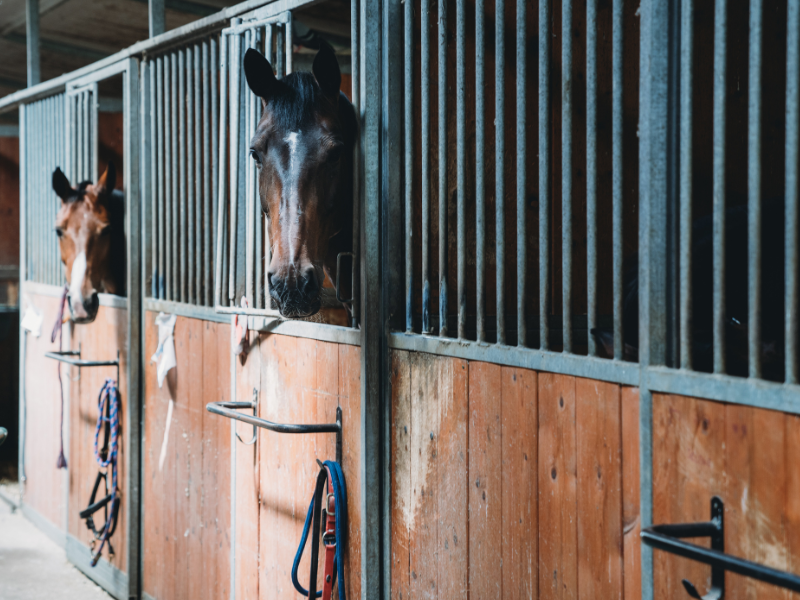
Offering a Horse Hotel on Your Property: Tips for Barn Owners
By Lorelei Wilson Coplen, USPC Board of Governors and USPC Founders Award Winner
To make some extra money, some barn owners may consider augmenting their income with a “horse hotel” business. While any size stable operation can run a horse hotel sideline, or secondary business, this can be an especially attractive idea for owners of small private barns. Small private barns are likely owned by a single family, and there might be a variety of reasons for that barn to have one or two empty stalls. In addition, a horse hotel, sometimes called a horse motel, operation is also a good opportunity for barn owners who may also want to offer commercial boarding. It’s important to think about if you really want someone else and someone else’s horses on your property? The horse hotel concept gives you a chance to try this out in a small manner before committing yourself to a larger, more commercial scale.
The Horse Hotel Concept
A horse hotel is not much like a human hotel but more like a horse hostel (a budget-friendly accommodation where guests rent a single bed in a shared space rather than a private room). You, the barn owner, provide a bed for someone’s horse—a safe, clean stall with fresh water in the buckets—for an agreed-upon price. You may also include extra services, such as cleaning the stall and/or feeding the horse in the morning for the owner. However, most other horse owner “wants” (e.g., turnout time, a wash stall, or a bale of hay) should be coordinated ahead of time (if possible) and should be an additional cost.
For several years, my small private barn has served as a horse hotel. We see both one-time travelers and regulars twice a year as they head north to south or east and west, and back. We are proud that we offer a safe and convenient layover for our horse guests and are glad to be there for their human partners when they have needed us, as well.
Getting Started
If you want to try offering a horse hotel at your barn, there are a few things to consider before you put out the proverbial shingle and advertise yourself in neon lights as “Open for an overnight stay.”
Do your homework. The most important homework here is to find out what your township/borough/city/county or even your state allows you to do on your property in your particular zone. You may live out in the middle of nowhere. You may already have horses and ponies come visit and overnight on your property all the time. But the moment you begin to advertise and charge for the privilege of the visit, the stay is a transaction and therefore “commercial.” Therefore, it may be prohibited in your zone. It usually does not matter how much or how little the compensation (cost) you receive is. It is still a commercial transaction, and you can find yourself in violation of an ordinance and fined an amount well above anything you planned to charge for the layover in the first place!
If your proposed horse hotel is prohibited in your zone, and you still want to do it, there is normally a procedure to follow to essentially submit for an exception to policy—although it may have another name, depending on your local government’s nomenclature. Be prepared to pay some fees along the process!
While you wade through your local ordinances—which you can usually find online at your local government’s website—check out the various ordinances for noise and lights (normally at certain levels and certain hours at night); parking (particularly streetside parking); waste management; leash laws; camping in unimproved camping areas; weight limitations on certain roads and bridges to your barn, and so on. Believe me, these are all topics you will want to know where you stand when you have to decide your own policies for strangers on your property.
Check with a lawyer. Once you know how to keep out of trouble with the local government, now think about your own status as a registered business. There are tax implications and you may need to reconsider your liability insurance as well. There is much more here than space for this article! .
Assess your facility. Now it is time to do a self-assessment of your facility. How far are you from a major highway or exit? This could be an important point as the most popular layover or horse hotels are easy exits from major highways, or they are located close to major competition venues. Then, pretend it is the first time you have had to find your barn—in the dark, in the rain, etc. That tricky turn by the jutting rock at the bottom of the drive? You know to pull wide around it so the trailer’s back tires do not get caught, but will a tired driver see that? Put a garden light next to the rock. The power wire that hangs over the driveway. No problem for your big rig, but remember when your friend Nancy came to visit with the hay rack on top of her trailer? Ouch! You might need to restrict layovers to rigs less than so many feet high. You could also ask a friend to do a candid assessment for you.
Determine your options. This is also the time to decide what you do—and do not—want to provide to your layover guests. If you have other horses on the property as permanent residents—including boarders—that may influence what amenities and services you may offer. At this point, you are not yet considering pricing—although that will be your next consideration—but how you plan to operate. For example, if your sole paddock is also your riding ring, then you may not be able to offer it for turn out at all, or only for limited duration or “if available.”
Decide how to advertise. It is remarkably easy, with a wide range of price points, depending on how visible you want your operation to be and which medium you use. The simplest way is through print media, such as through your organizational magazines or through newsletters, whether print or digital. While print can be expensive, these sources have one general advantage for you to consider as a horse hotel host: those folks with access to that resource are usually members of the same organization you are, as well. Many organizations also offer online advertising options, which may be more affordable, and online classified advertising can fit just about any budget.
The most effective advertising is found in the plethora of online horse travel websites. Decades ago, a clever person figured out how to consolidate the various horse-related small businesses out there and advertise them for an inexpensive annual cost. Naturally, the big tech companies bought them out, but the sites are still there and still cashing in. Yes, they are inexpensive, but they are also open to anyone looking to move any livestock from one place to another. You may find yourself receiving some very odd requests.
Build a website. The most efficient advertising method, but also the most time-consuming on the front-end, is your own website. However, all businesses should have a website. Depending on your skill level, you can do this yourself with limited expenses. Of course, if you already have a website for your farm, adding a page or several for the new horse hotel business is fairly easy.
Whether standalone or an add-on, the best horse hotel sites mimic lodging websites for people and include pictures of “rooms” (aka, stalls); the driveway, and entry and exit points; and any other included or offered amenities. For added simplicity, it can include a calendar function that blocks out the unavailable dates with a “Book Now” feature. Or, you can simply have a phone number, which means it’s up to you to keep track of who called you, when, and for what dates.
Outline what is offered. Your website is also the space to outline what is offered: For example, “Each stall is at least 10’ x 12’ wood plank sides to 5’ with iron bars above to a total of 14’. Stalls have rubber mats over concrete and are bedded in wood shavings. There will be two filled water buckets in each stall (one heated, in season) and two fans hung high on the ceiling (in season). Please inform us within 24 hours prior to arrival if you need to make changes to these arrangements (e.g., no shavings). We will also feed your horses for you in the morning so you can sleep in!”
You can also indicate what additional amenities and services you will offer. For example, “Grass hay available at $10 per bale; limit two bales per visit. A paddock is available for limited hours at $10 per hour; must remain on site; and there is no guarantee of availability.”
It is also important to make your expectations clear, such as:
- Guests must present an inter-state horse health certificate and valid Coggins documentation before unloading.
- Halters must have a break-away strap and remain on horses at all times.
- Dogs must be leashed.
- Children under 18 years of age must be attended at all times.
- Drop trailers and park cars in designated areas only.
- Hay must be on ground or in a hay feeder. Hay nets are not allowed.
- No human accommodations are available. Camping or using trailer living quarters overnight is not allowed.
Your expectations list is also your checklist when your guests arrive in your driveway.
Decide which payment methods to accept. The website with a “Book Now” feature can also be set to take a reservation—name, email, phone number, and/or address—with payment. For your purposes, you need to know how many horses, what size they are, mares or geldings (I recommend not taking stallions, but that is up to you). Also, ask their preferred contact when they are travelling. This last is vitally important when you have to reach them to tell them about the tree that is across the road to your place, about flooded highways, or about the ice storm that is on the way.
If payment online is too complicated or expensive for you, you can wait to get payment on arrival, with obvious drawbacks. You can still use a handheld machine or an app, and in the old days, those travelling with horses would expect to arrive with cash or a check. Some folks still expect to do that now.
These are just a few of the things that will need to be considered if you are a barn owner considering offering a horse hotel. It’s a great way to meet amazing people, including fellow Pony Club members. But it takes considerable research, some expense up front, advertising to find people, and more. Then the adventure begins.
Safe hosting!

USPC National Office
The United States Pony Clubs, Inc. (USPC or Pony Club) is the largest equestrian educational organization in North America. Started in 1954, the organization has developed curriculum that teaches safe riding skills and the care of horses through mounted and unmounted lessons. Through Pony Club, members have fun with horses and make lifelong friends while they develop skills, habits, and values that extend well beyond the barn and last a lifetime. Many members apply what they have learned in the USPC program successfully in their careers, educational and volunteer opportunities, and other life pursuits.

You May Also Like

American Horse Council Marketing Alliance Announces New Team Challenge

The Importance of Being an Intern in Many Horse-Related Careers, and Beyond
