
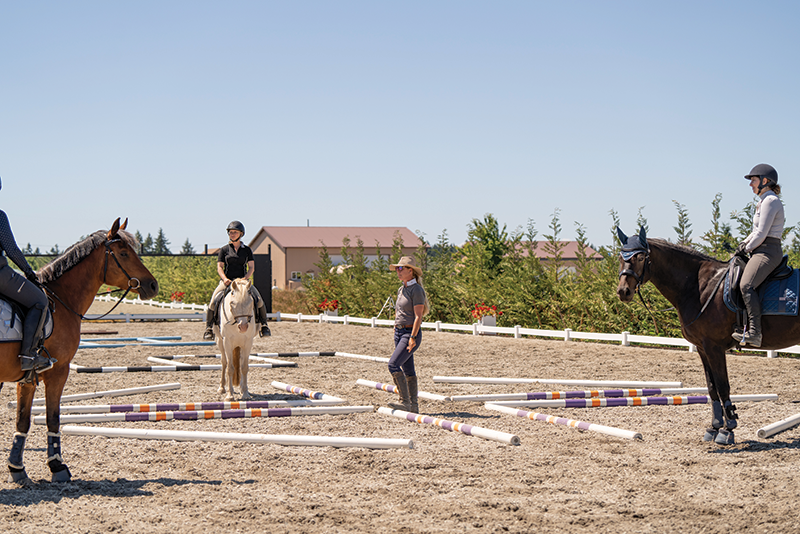
The Power of Pole Work
By Christine Headley, H-A HM, A EV alum and former DC of Equitese Pony Club
Ground poles and cavaletti are among the most versatile training tools available to riders of all levels. They can benefit every breed of horse in any discipline! Regular pole work builds strength, balance, and confidence, and strengthens the topline, aids in joint articulation, and teaches the horse proprioception (a sense of his own body position, force, and movements). Pole work can be part of ongoing conditioning, cross-training, or physical rehabilitation for a horse. Ingrid Klimke, a well-known German rider in international Eventing and Dressage, advocates for cavaletti work as an indispensable training tool for all horses and riders, because it promotes gymnastic development, strength, rhythm, and suppleness.
Riders can start over poles at the beginner level (D-1) in the walk and trot once they have balance in the saddle and have learned basic steering skills. At this level, it can help riders learn rhythm, to look ahead, and help their coordination. At the D-2, D-3, and C-1 levels, cavaletti work is beneficial for developing feel for the horse’s length of stride, for practicing half halts, and for improving balance. More advanced riders at the C-2 levels and above can use cavaletti exercises to work at various gaits and heights for developing engagement; cadence; free, forward movement; and connection; along with changing stride length.
Benefits Across Disciplines

Ground pole and cavaletti work is a universal cross-training tool that can benefit each discipline offered in the various Pony Club tracks, and many disciplines beyond that. Dressage, Hunter Seat Equitation/Show Jumping, Eventing, and Western riders may use them slightly differently, but the reasoning is the same: they help improve rhythm, balance, and coordination.
Dressage: Working over poles for Dressage develops rhythm, impulsion, suppleness, and straightness—the building blocks of the training scale. (For more on the training scale, read “Scale Up Your Ride” on page 20.) Walk/trot poles encourage consistent tempo and adjustability. Cavaletti at the trot/canter build cadence, thrust, and engagement of the horse’s hindquarters, which ultimately builds topline strength while testing the horse’s balance. Offset poles, fan patterns, or curved lines improve straightness and suppleness.
Hunter Seat Equitation/Show Jumping: For Hunter Seat Equitation and Show Jumping, trot/canter poles prepare the horse and rider for jump courses by helping them build confidence in seeing distances and maintaining rhythm between fences. It develops stride length control, balance, and the horse’s adjustability over fences while improving the rider’s “eye” for approaching a fence. Gymnastic grids with poles teach horses to stay straight and riders to maintain their position. Adding cavaletti exercises to your weekly routine can encourage a correct bascule (arc over the jump) without over-jumping your horse (having him jump too big and/or too much).
In his teachings, author, clinician, and equestrian Denny Emerson is also a fan of using poles. “There are ways to develop your feel for the ‘right’ canter, one which combines enough impulsion and enough balance, neither one overwhelming the other, that don’t pound on your horse by making him jump, jump, jump,” he said. “One way is by placing poles on the ground all over the place and ride to the poles, seeing whether you can adjust the stride to nail good distances, then repeat and repeat. You will develop two things, your eye for a distance and your feel for a better canter.”
Eventing: For Eventing, the benefits stated above for Dressage and Hunter Seat Equitation also apply. To improve an event horse’s cross-country skills, pole work with cavaletti mimic the uneven terrain of a cross-country course, encouraging quick footwork and strengthening the horse’s joints and ligaments. Poles also reinforce multi-discipline readiness, preparing the horse for the challenges of all three phases of Eventing.
Western: For Western riding, poles can prepare the horse for performance patterns by teaching rhythm, body control, and accuracy in foot placement. Walking/jogging over poles builds cadence for western pleasure or ranch riding. Cavaletti used in trail classes simulate obstacles and improve the horse’s care in where he places his feet. Loping over poles develops lead control, straightness, and adjustability. By incorporating poles into your Western horse’s training program, you can improve your horse’s balance, responsiveness, and precision in gaited maneuvers.
Riders in all four USPC discipline certification tracks will find common benefits in these four areas:
- Rhythm and tempo control,
- Balance and straightness,
- Strength and proprioception of the horse, and
- Rider position, timing, and feel.
Ground pole and cavaletti exercises are a useful “bridge” tool in Pony Club—they let a rider see and feel how flatwork translates into jumping, obstacles, and advanced maneuvers in any discipline.
Ground poles and cavaletti are like gym equipment for the horse—they build strength, coordination, and awareness in ways that plain flatwork alone can’t always do. For jumping, polework can help the horse and rider practice the fundamentals without the wear and tear on a horse’s joints and ligaments from over-jumping.
Benefits for the Body
Working over ground poles and cavaletti provides horses with a wide range of physical and mental benefits while adding variety to training routines. Pole and cavaletti work strengthen the horse’s muscles by engaging the core, hindquarters, and topline. As the horse lifts his legs and back over poles, he learns to use his body correctly rather than hollowing out his back.
This work also improves balance and coordination as the horse becomes more aware of where his feet are and learns to distribute his weight evenly across all four legs. Another advantage is increased joint mobility and flexibility. Repeatedly stepping over poles helps to expand the range of motion in the shoulders, hips, and hocks while keeping the horse’s body loose and helping to prevent stiffness.
Pole work also has a positive effect on the quality of the gaits: walk and trot poles encourage a steady rhythm and clearer, more active steps while cavaletti at the trot or canter improve cadence, elasticity, and suspension. This type of exercise also supports overall conditioning by building cardiovascular fitness in a low-impact way and prepares horses for more demanding work.

Benefits for the Mind
Beyond the physical benefits, pole work is also valuable for the horse’s mind. It requires focus and attentiveness since horses must watch their feet and adjust accordingly, which also fosters connection to the rider’s aids. Navigating poles builds confidence, starting with simple patterns and gradually preparing horses to handle more complex challenges.
Pole and cavaletti exercises also help break the monotony of routine schooling by keeping training sessions engaging and reducing the risk of sourness or boredom. Many horses find comfort in the regular rhythm of pole work, which can encourage relaxation and a positive mental state.
Suitable for a wide range of riding goals, this powerful training tool offers benefits that reach far beyond the arena.
Why Instructors and Clubs/Centers Should Add Pole Work to Lessons
We all know how important it is to keep lessons engaging and interesting for both riders and horses, including school horses who may be doing the same thing day in and day out. Pole work, which works for all disciplines and at every level, can fit into any program and does the following for your students:
- Skill Progression: Provides a natural way to teach rhythm, steering, balance, and coordination before introducing more advanced movements or jumps.
- Low-Impact Alternative: Lets riders practice adjustability, distances, and “the feel of the right canter” without over-jumping horses.
- Confidence Builder: Simple, structured challenges help green horses and new riders gain confidence without overwhelming them.
- Engages Riders: Fun, interactive exercises that make mounted lessons dynamic and memorable.
- Easy Setup: Requires only a few poles to create dozens of exercises, which are adaptable indoors or outdoors.


This is an excellent way to work your horse through various routes using the pole setup. One of Headley’s favorite ways to use this is doing three- and four-loop serpentines, while working on balanced turns and straight lines.
This article was originally published in the 2025 Fall/Winter issue of Discover USPC magazine. Read more content from that issue.

USPC National Office
The United States Pony Clubs, Inc. (USPC or Pony Club) is the largest equestrian educational organization in North America. Started in 1954, the organization has developed curriculum that teaches safe riding skills and the care of horses through mounted and unmounted lessons. Through Pony Club, members have fun with horses and make lifelong friends while they develop skills, habits, and values that extend well beyond the barn and last a lifetime. Many members apply what they have learned in the USPC program successfully in their careers, educational and volunteer opportunities, and other life pursuits.


You May Also Like

U.S. Dressage Team Pushes Through Tough First Day of Competition in the Grand Prix at the 2024 Olympic Games in Paris

Grooming Expert Cat Hill and Julia Magsam, one of the stars of the USPC Documentary
